STEM at Work – Perspectives from Research Careers
 Play video: Video from “STEM at Work – Perspectives from Research Careers”
Advancement in scientific careers often requires postgraduate degrees and research experience. In this month’s Community Call, we engaged in an extensive and expository discussion with top-level professionals working in different contexts – graduate school, teaching, and industry.
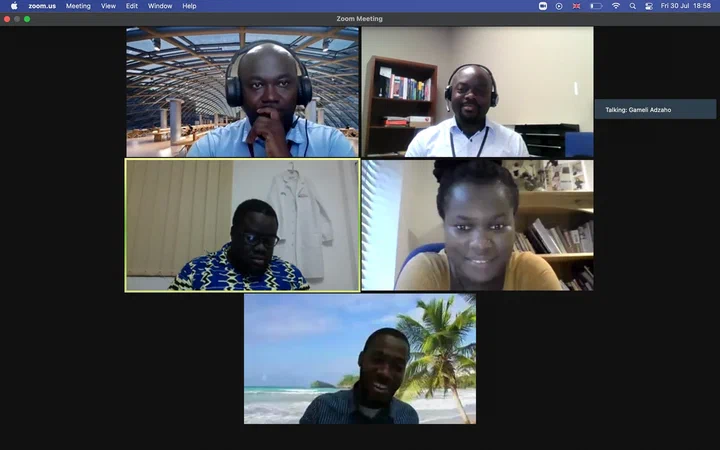
Joining the call were members of the GLab Community and many students from the Department of Biochemistry Cell and Molecular Biology of the University of Ghana and beyond. The speakers were Dr Benjamin Owusu (Labcorp, USA) Dr Kwabena Sarpong (Lecturer, University of Ghana) Lois Damptey (PhD student, Open University UK), and Dr Patrick Osei-Owusu (Researcher, University of Chicago).
In an effort to address specific questions targeted at the needs of the audience, the discussion took a ‘question and answer’ approach. The session began with an eye-opening introduction from the speakers about their lives and career journeys, highlighting how they transitioned from their undergraduate degrees, through postgraduate education, to their current positions.
Diving into the first question ‘How can you make an impact with research?’, Dr Osei-Owusu shared his experience working on the Covid-19 vaccine development and how findings from the research were instrumental in developing safety protocols. He also emphasized the importance of choosing priority topics that have direct impact on human lives and communicating the findings from such research in a relatable manner. Dr Benjamin Owusu stressed the importance of enjoying the process of research. He shared that “ whether you are in the basic science stage of research or the translational stage, you are making an impact and it is relevant to enjoy the process”.
Addressing the second question “What skills are critical for someone who wants to go into research?” Dr Benjamin Owusu mentioned critical thinking, curiosity and continuous learning as essential skills for researchers. In addition to these skills hard work, collaboration and networking were noted to be key skills in successful research careers. Dr Kwabena Sarpong shared the ‘not-so-glamorous’ aspects of research and reiterated the essence of building resilience as a researcher. He also mentioned the importance of developing oral and written skills. In an age of information technology, he stated that it is important to have coding skills as it is evolving to be the basics for STEM.
Following this incisive discussion, the speakers went on to discuss the question ‘How is it like trying to get into graduate school in the US?’ The main points highlighted include:
- Starting early which translates into being intentional about the application process
- Building a relationship with your prospective tutors; being upfront about your research interests
- Building a community of like-minded people (Networking)
- Writing a well-crafted CV
- Networking and guidance
- Writing the GRE
Dr Kwabena Sarpong affirmed that it is normal to get rejections after applying to schools. As a means to hedge any unfavourable outcome, it is recommended to apply to a selected number of schools.
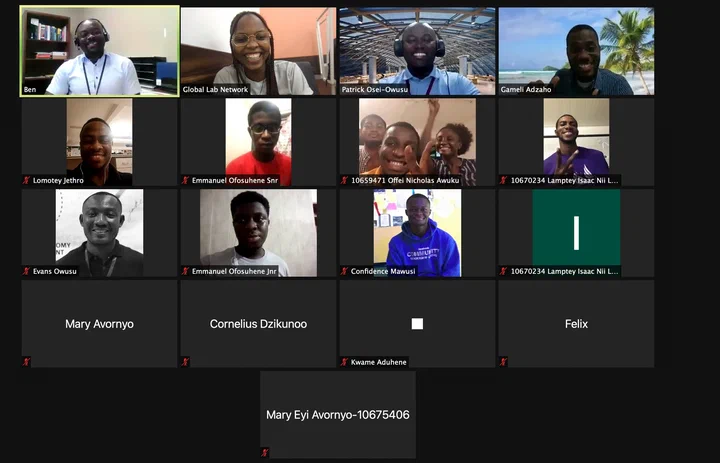
Sharing experiences from the UK and European contexts, Lois Damptey shared how personal initiative was instrumental in her ability to secure fully funded scholarships while highlighting the role of friendship and network in attaining goals. She also shared her volunteering and international experiences and explained the role of such engagements in building her portfolio in preparation for graduate school.
A number of scholarship opportunities and resources were shared in the meeting. Some of these include Python for Science, Freecodecamp’s ‘Python for Scientific Computing’ that teaches beginners how to apply python programming to science and the Coursera platform. Lois also shared the ‘Dear Young Graduate group page and other scholarship websites like Chevening, DAAD, the SINGA Awards and Swedish Institute (SI).
To conclude the session, Dr Fredrick Larbi joined us to reaffirm the need for a Ghanaian Science funding programme.
The Community Call proved to be insightful with speakers selflessly offering an unadulterated account of their education and career. Participants were very engaged through questions and comments. The session achieved its objective of exploring research careers in working in different contexts and introducing participants to graduate school application processes.
You’re welcome to join the Global Lab Ghana Community on Facebook if you’d like to be engaged on STEM topics and opportunities. Follow us on Twitter and subscribe to our YouTube Channel to be updated on our various activities.