The Art of Communicating Science -Bridging the Gap Between Science and Society
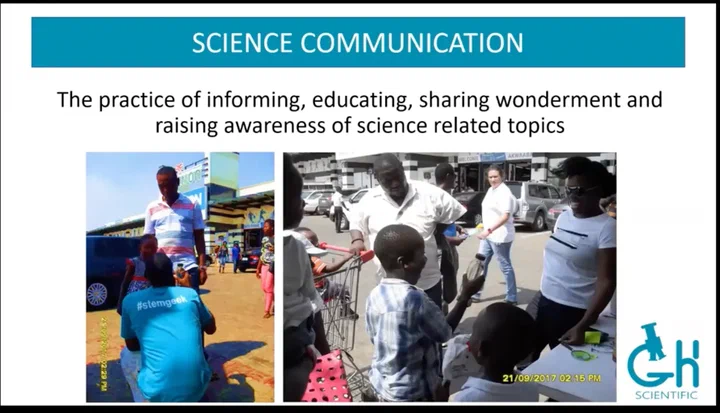
Technical knowledge from complex scientific research findings can be difficult to communicate to general populations with no scientific background. Communicating science to a wide range of audiences is hence argued to be a science in its own right. As an open science community with a definitive goal to deepen public understanding of, and participation in, science to ensure a cultural shift towards a knowledge-led society, this month’s Community Call was focused on “The Art of Communicating Science”. The event was targeted at equipping participants with some approaches used by renowned scientists to bridge the gap between scientists and the general public.
The speakers included Dr Paul Owusu Donkor, a lecturer at the University of Ghana School of Pharmacy; Dr Angela Tabiri, AIMS–Ghana; Dr Thomas Tagoe, founder, GhScientific.
The programme attracted participants from different African countries and around the world. It provided the platform for the participants to not only receive impactful ideas but to also share their own thoughts on critical issues in science education and communication.
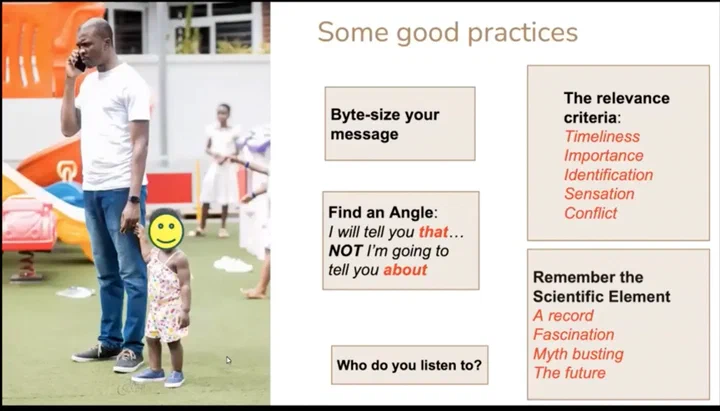
Delving into the topic in a fun and experiential approach, Dr. Donkor explained Science Communication to be the practice of informing, educating, sharing and raising awareness of science-related topics. He shared that meaningful science communication and science-related initiatives influence society positively.
Dr. Donkor mentioned 10 key elements that individuals should harness to achieve a successful science communication. The first five elements are 4Ws (what, why, when, where) and H (how). With “what”, he said one had to carefully assess the content he wants to deliver and establish it within a scientific context. “Why”, he said, should direct one’s intention for embarking on science communication.
Talking about “when”, he said it defined the moment science communication should be done. He intimated that science communication could be done anytime as appropriate and also it should go with trends. The “where” element, Dr. Donkor said, included both physical – schools, communities, etc – and online spaces – LinkedIn, Twitter, Facebook, YouTube, Wikipedia, Instagram, etc.
Dr Donkor, however, explained that individuals needed to learn skills and techniques on how to present using online spaces, saying “there are etiquettes that guide virtual presentations”.
To illustrate the “how” element, Dr. Donkor included the channels one should use to churn out his or her messages. He said one could do science communication through talks, meetings, performing arts, online content, policy briefs, interviews and outreach.
The other five elements Dr. Donkor indulged Science communicators to employ are the sender, the receiver, the channel, the topic and the language. To make a good impact with science communication, he entreated individuals not to compromise the use of local languages or vernacular. “If you have command over the local language or vernacular, you are well able to communicate your science. Let us not limit our communication to English. If we want to communicate to the society, we must break down our communication using the suitable language,” He said.
Dr Angela Tabiri elaborated on a suite of projects and activities she initiated as a way of grooming young girls and women to pursue STEM.
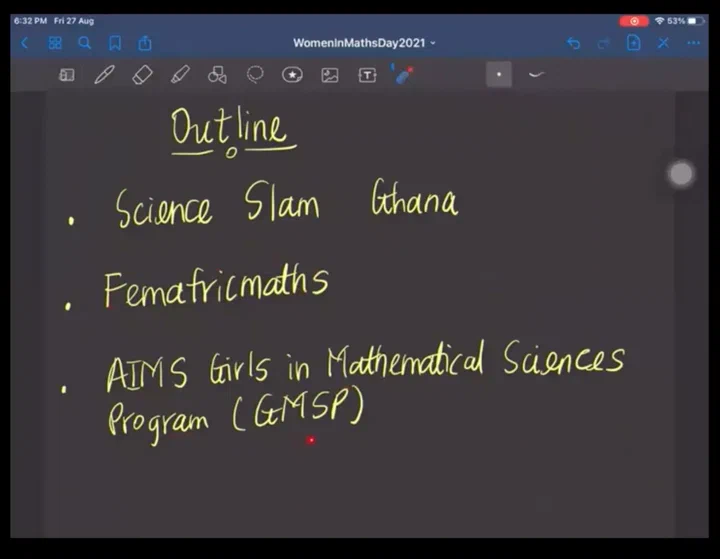
The initiatives included Science Slam Ghana – a science communication event where researchers share their research to a lay audience in an engaging way –; Femafricmaths (Female African Mathematicians) – an initiative that employs the use of social media to tell stories of female mathematicians. Another initiative she mentioned was AIMS Girls in Mathematical Sciences Program (GMSP). It sought to nurture Senior High School (SHS) students and sensitise them on the relevance of studying mathematics. Dr. Tabiri noted that the GMSP also had been offering scholarships to girls.
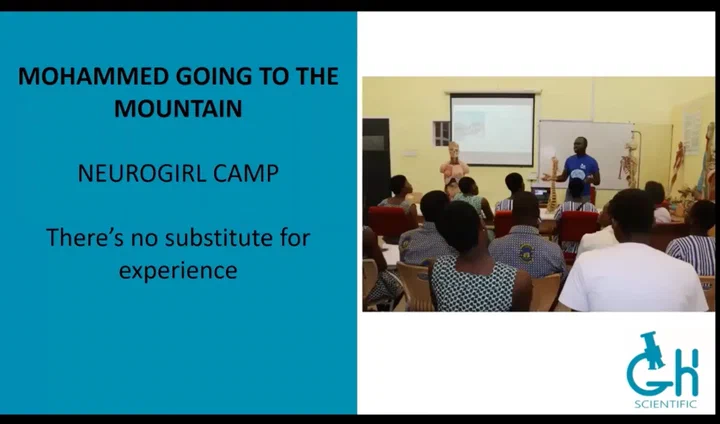
Dr Tagoe, highlighted the need to adopt a dynamic approach in taking science to the people. Citing examples, he shared how his outfit strategically engaged SHS students by taking them to universities and laboratories to gain practical experiences. He added that his outfit had also stepped onto the streets to demonstrate and bring science closer to the people. Dr Tagoe also shared how individuals could use art to tell science with examples from GhScientific’s Evolution of Science project.
Joining in the conversation, Prof Dr Ing Henry Nii-Adziri Wellington of the Ghana Academy of Arts and Sciences (GAAS) stressed on the need to use the local languages, saying, “English is okay to be used in class but on the street, vernacular is okay”. He was of the view that one does not only speak to a person’s mind but heart, when one communicates with a person in their mother tongue.“Let science inform your mind and heart. It is when you speak to the person’s heart and inner being that you can transform,” Prof Wellington.
The conversation concluded in a robust round of questions and contributions from the participants. Prof Elsie Effah Kaufmann of the National Science and Maths Quiz (NSMQ) fame also stressed on the need to communicate science in the language that connected with local audiences and meaningfully piqued their interests.
 Play video: Video from “The Art of Communicating Science -Bridging the Gap Between Science and Society”
Don’t forget to make a date with us on Friday, 24th September 2021 to engage with renowned speakers and community members as we bring you this month’s Science Cafe.
Join our Global Lab Ghana Community on Facebook , follow us on Twitter and on Youtube to stay updated on our events. You’re welcome to register via this link if you are interested in sharing your work or research.