The Universe in Focus: Insights into Cosmology and Astronomy from Experts in South Africa and Ghana
What is the fate of the universe? How can all Africans benefit from Square Kilometre Array (SKA)? Is raising awareness about the universe without implementing school curricula not like putting the cart before the horse? And do black holes exist literally? These were among the many fascinating questions asked by the participants of the Science Cafe held online on 25 June, 2021.
Understanding the origin of the universe, including our earth, has always been a subject of human curiosity, raising many thought-provoking questions like the above ones. To answer these questions, we were privileged to host two speakers with outstanding track records in research, teaching, and public engagement in astronomy, during the June 2021 edition of Science Cafe. A first for the series, we had an international speaker in the person of Professor Bruce Bassett of the University of Cape Town, African Institute for Mathematical Sciences (AIMS South Africa), and the South African Astronomical Observatory (SAAO). Our second speaker, Sarah Abotsi-Masters, is the General Secretary of African Astronomical Society (AfAS), and Weekend Coordinator at the Ghana Planetarium, among other key roles in local and international initiatives. Together, they served a composite view of astronomy and cosmology, giving attendees a truly special experience.
GLab Lead Gameli Adzaho kicked off the meeting with an overview of Science Cafe, why it is important, and how we have adapted the model so far. Next, a poll was launched to determine the knowledge and interest of the attendees on Cosmology and astronomical resources in Ghana.
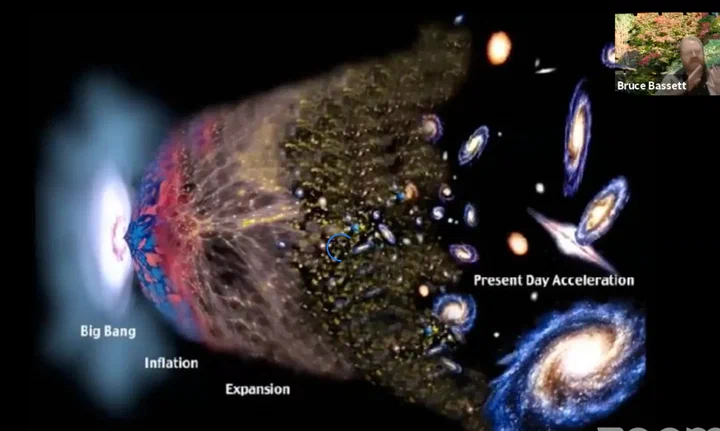
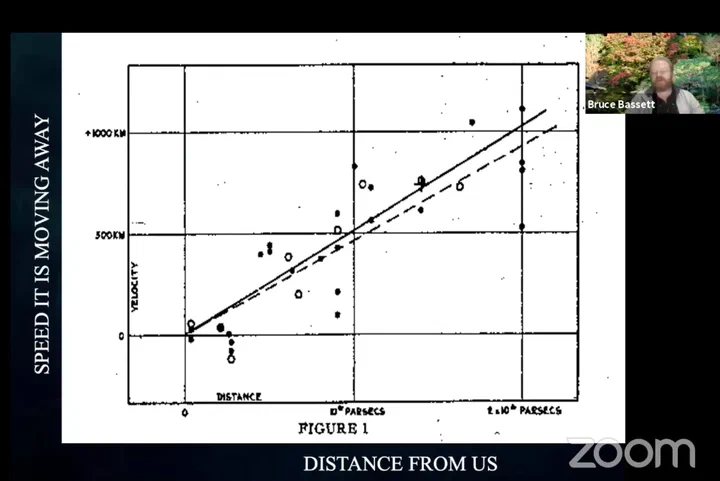
Professor Bruce Bassett set the tone for the discussion with a stimulating presentation on Cosmology; what we know about the universe, mysteries and new tools for astronomy and cosmology in Africa. In his presentation, Bruce gave an excellent illustration of reductionism, how complex phenomena are simplified in the scientific process, with an apple. He defined Cosmology as the study of the whole universe and everything we are in contact with and mentioned the importance of physics in understanding the origins of the universe. Following an illustration of galaxy clusters, Bruce explained how gravity pulls galaxies together and empties out the void leaving a bubble pattern using a map of the universe. Some of the mysteries of the universe he shared were:
- Most of the matter in the universe is dark and invisible to us.
- The cosmos is expanding in a very strange manner. The universe is getting bigger at a fast pace.
On some very large scales what we have is anti-gravity as the expansion of the universe started to speed up 5 billion years ago
Professor Bruce Bassett
Prof Bassett further discussed the Square Kilometre Array (SKA) project, which aims to build the largest network of telescopes to study the universe (two-thirds of these telescopes are expected to be in Africa, with the remainder in Australia). He concluded on the note that there are several amazing discoveries about the universe however, there exist many more mysteries that are yet to be understood.
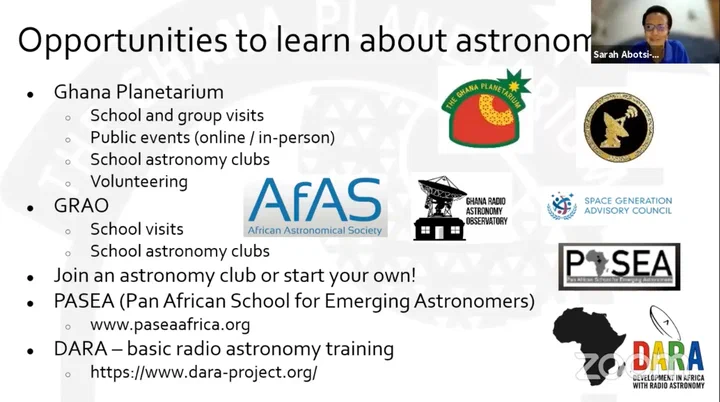
Sarah Abotsi-Masters took off from Prof Bruce Bassett with an overview of astronomical resources in Ghana. She emphasized on the interconnectedness of astronomy to other disciplines and the importance of astronomy to the achievement of the Sustainable Development Goals. Despite the inadequacy of support for astronomy in Ghana, which is demonstrated in the lack of undergraduate astronomy courses, Sarah mentioned some notable organizations dedicated to promoting the study of astronomy in Ghana. They include, Ghana Planetarium, All Nations University and the Radio Astronomy Observatory. Sarah shared some opportunities for learning astronomy like the Development in Africa with Radio Astronomy (DARA) project and Promoting Radio Astronomy in Ghana through School Visits and Clubs (PRAGSAC). At the end of the presentations, the questions raised by the attendees were answered by the speakers in a thought-provoking conversation.
In the pre-event poll conducted at the beginning of the session, 11% of the participants stated that they had hardly heard of the topic under discussion while 78% stated that they had some idea with 11% engaged in some research in the area. At the end of the discussion however, the majority of attendees totalling 86% found the discussion stimulating and amazing.
The Science Cafe was educating and eye opening, and met its objective of offering participants a new and informed perspective of the world beyond the earth, with a clearer understanding of the evolution of the universe, and increased awareness of latest scientific developments in Africa.
If you’re a researcher, innovator or artist who would like to speak at a future Science Cafe, please send us a proposal through our Speaker recruitment form. However if you’re interested in our programmes but not quite ready to speak just yet, you can join our Facebook Community or follow us on Twitter to remain updated!